Managing Financial Stress with Acceptance and Commitment Therapy (ACT)
Do you find yourself worrying a lot about money and finances? You are not alone. With a downturn in the...
Read More →

Have you ever noticed the impact a single thought can have on your mood or behaviour? You might be feeling quite good then all of a sudden, a thought pops into your head — “I’m not good enough”, “this is going to go badly”, “I always mess this up” — and suddenly your mood has dramatically changed and that one thought is running the show. Within moments, that thought has taken over and you are responding to it as though it is fact or command.
This is what happens when we become ‘fused’ with our thoughts. We stop seeing them as passing mental events and start treating them as facts — as truths we must respond to. And when that happens, the thought stops being just a thought. It becomes a directive.
Most people, at some point, have been told to “just stop thinking that way.” And most people discover, fairly quickly, that this is not actually possible. Trying to force yourself not to think something tends to make it more persistent, not less. I see this regularly in clinical work. People arrive having tried very hard to think differently. They have challenged their thoughts, argued with them, reasoned their way through them, distracted themselves from them. And yet the thoughts keep coming back, carrying the same (or not worse) weight, triggering the same reactions. What has not been working is not the person’s effort. It is their approach to their thoughts.
Cognitive defusion offers a different — and I think in many ways, easier — approach entirely. It comes from Acceptance and Commitment Therapy (ACT) and it is one of the tools I find genuinely useful in clinical work, as well as in my own life. The aim is not to get rid of difficult thoughts but to change how much power they have over what you do next. In this article I want to explain what cognitive defusion is, why it matters for anxiety, depression, and stress, and how to begin practising it in a way that makes a real difference in daily life.
In this article I want to explain what cognitive defusion is, why it matters for anxiety, depression, and stress, and how to begin practising it in a way that makes a real difference in daily life.
Cognitive defusion is the practice of stepping back from your thoughts so that you can see them for what they are — mental events, not facts. When you are fused with a thought, you experience it as truth. When you are defused from it, you can notice it, name it, and then choose how — or whether — to respond.
The word ‘defusion’ refers to the opposite of ‘fusion.’ Fusion happens when a thought and reality feel like the same thing. You think ‘I’m a failure’ and it feels every bit as real and present as the chair you are sitting on. Defusion creates just enough distance between you and the thought that you can observe it rather than be ruled by it.
A simple way to feel that difference: think the thought “I can’t cope with this” and notice how it impacts you. Now try saying to yourself, “I’m having the thought that I can’t cope with this.” For most people, there is a subtle but meaningful shift. The thought is still there but it has moved from being a statement of fact to being something your mind is producing. That gap is what cognitive defusion is. It is our ability to step back from our thoughts and observe them, rather than automatically accepting them as truth and reacting to them.
Cognitive defusion emerged as part of Acceptance and Commitment Therapy, developed by psychologist Steven Hayes in the 1980s and 1990s. ACT took a different approach to thoughts than much of what had come before. Cognitive Behaviour Therapy (CBT) encourages us to identify unhelpful thoughts and actively challenge or reframe them, and this approach has real merit in many contexts. The limitation, as touched on earlier, is that deliberately changing what we think is harder than it sounds. For many people, particularly those with chronic anxiety, depression, or long-standing patterns of thinking, the effort of trying to think differently can become exhausting, and the thoughts tend to return regardless.
This was a meaningful shift clinically. In ACT, rather than focusing on changing the content of a thought — challenging it, replacing it, arguing with it — the focus shifts to changing your relationship to it. Defusion offered something different. Instead of fighting the thought, you simply notice it and let it move through without needing to act on it. The goal was not to have better thoughts, but to be less dominated by the ones you already have.
Defusion Versus Suppression
It is worth being clear about what defusion is not. It is not trying to push thoughts away, replace them with positive ones, or tell yourself to stop thinking something. If anything, that kind of suppression tends to make thoughts more persistent, not less. We all know the experience of trying very hard not to think about something and finding it impossible.
Defusion is different. You are not asking the thought to leave. You are simply changing your relationship to it — from being inside it, to being able to observe it from a small distance. To be able to look at the thought and be curious about it and not see it as something bad, or something about you that needs to change.
Why It Matters for Anxiety, Depression, and Stress
Anxiety
If you have ever experienced anxiety, you will know how quickly and convincingly the mind can generate reasons to worry. It presents worst-case scenarios with a kind of urgency that makes them feel not just possible but definite. When we are fused with anxious thoughts, we respond to them as if the threat is real and present — even when it is a projection about something that may never happen. We don’t see this as just a perspective our mind has, but as reality itself — and we react accordingly

What defusion does in this context is interrupt the chain from thought to reaction. When you notice “there’s the thought that something will go wrong” rather than experiencing it as a fact, the physiological reaction tends to settle. You can see the thought as your nervous system trying to protect you — which it is — without needing to treat its prediction as certain.
Over time, this also reduces the checking, reassurance-seeking, and avoidance that tend to keep anxiety going. When thoughts have less power over behaviour, you can do things even when the thought says not to. And that is how exposure happens — not by eliminating the anxious thought, but by acting anyway while holding it lightly.
Depression

For people experiencing depression, the thoughts that tend to cause the most damage are the ones about themselves.
“I’m worthless.”
“I’m a burden.”
“Nothing I do makes any difference.”
“Im useless at life”.
These are not just distressing thoughts. When fused with them, they shape everything: our motivation, behaviour, and how we interpret what happens around us.
Defusion helps us recognise these narratives for what they are — one perspective the mind is offering in that moment, but not the only one, and not necessarily the most accurate one. This happens not by disputing the thought — “but you’re not worthless” — but by helping us see it as a story the mind is telling, rather than an accurate description of who we are. When “I’m worthless” becomes “my mind is offering the ‘I’m worthless’ story again,” it becomes possible to act differently than the thought suggests. That is the beginning of behavioural activation — doing things not because you feel motivated or deserving, but because doing them aligns with your values.
Stress
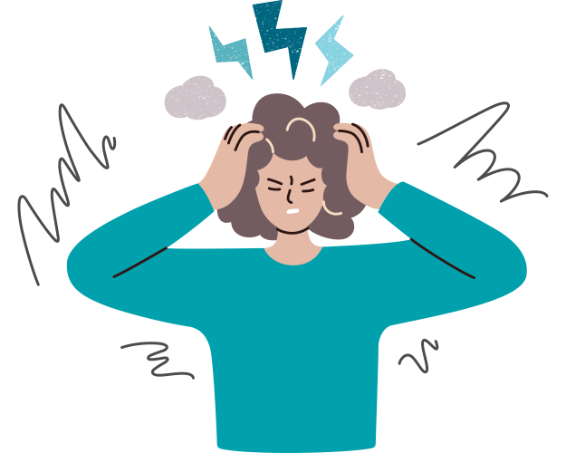
Under pressure, the mind tends to narrow and we find it difficult to see alternative perspectives. When we are stressed, fused thinking gets worse — everything feels more certain, more catastrophic, more permanent. It is not uncommon to think such thoughts like,
“This is too much.”
“I can’t handle this.”
“It’s all going to fall apart.”
Defusion in these moments is not about being calm. It is about creating just enough space between you and the thought that you can still access your capacity to problem-solve and make decisions. When you are inside the thought, you are reacting. When you can observe it, you have a little more choice about what to do next.
These are not complicated exercises. Many of them take less than a minute and can be done in the middle of an ordinary day. The goal is simply to shift your relationship to a thought in the moment it appears.
Labelling the Thought
One of the most straightforward defusion techniques is simply naming what your mind is doing. When a thought arrives, rather than engaging with its content, you label it.
“There’s the ‘I’m going to fail’ thought.”
“My mind is offering the critical story again.”
“There is the Inner Bully.”
“That’s the catastrophising one.”
The label doesn’t need to be clever. It just needs to be accurate enough to create a small observational distance. When you notice you are noticing, you are no longer fully inside the thought.
This one often gets a reaction when I first introduce it, but bear with me. When an unhelpful thought appears, try saying — silently or aloud — “Thanks, mind.”
The reason this works is that it acknowledges the thought’s function without accepting its content. Most of our difficult thoughts are trying to keep us safe or prepared. They are not malicious — they are habitual. “Thanks, mind, I can see you’re trying to protect me here” changes the tone of your relationship to the thought without making it true.
It also tends to reduce the struggle. When we fight our thoughts, we give them energy. When we acknowledge them neutrally, they often lose some of their urgency.
Distancing Language
Language has more power over how we experience our thoughts than most people realise. A small shift in wording can make a meaningful difference to how fused you feel.
Compare: “I’m a failure” with “I’m having the thought that I’m a failure.”
Or: “I can’t cope” with “My mind is telling me I can’t cope.”
These are not positive affirmations. They are just more accurate descriptions of what is actually happening — which is that your mind is producing a thought, not delivering a verdict.
Some people find it useful to add their name: “Vanessa is having the thought that…” Speaking about yourself in the third person creates an extra layer of observational distance that can be surprisingly effective.
Putting the Thought on a Leaf
This is a visualisation that works well for people who engage easily with imagery. When a thought arrives, imagine placing it on a leaf and watching it float down a slow-moving stream. You are on the bank. The thought passes through your field of view and continues downstream.
You are not pushing it away or following it — just watching it move through. If your mind pulls you back in, gently return to the bank and observe again.
This works because it gives the thought somewhere to go. Rather than looping, it can be seen as transient — which, ultimately, all thoughts are.
Saying It in a Silly Voice
This technique isn’t the most elegant and probably sure to make you feel a bit silly, but it often is surprisingly effective. If a thought has a particularly strong pull — something you keep returning to, something that feels heavy and certain — try saying it aloud in a very different voice. A cartoon character, a slow drawl, whatever feels sufficiently absurd.
The aim is not to mock the content of the thought, but to break the spell of its seriousness. When we fuse with a thought, it tends to feel weighty and authoritative. Changing its delivery shifts that quality.
In clinical work, cognitive defusion sits within the broader framework of ACT alongside acceptance, values clarification, and committed action. It is rarely used in isolation — rather, it is one of several tools that work together to increase what we call psychological flexibility.
What I find useful about defusion in therapy is that it does not require us to challenge or restructure their thinking. For clients who are exhausted by their own minds, being told to examine and dispute every thought can feel like yet another demand. Defusion offers a different path: rather than working harder against the thought, you simply hold it differently.
Exercises are practised both within sessions and between them. I often ask clients to keep a simple log of the thoughts that pull them in most strongly, and which defusion technique seemed to create the most useful shift. This builds awareness over time and helps us find the approaches that suit their particular style of thinking.
Something I notice consistently when introducing this concept to clients is a sense of relief that the experience of being taken over by a thought is not unusual, and that there is something that can actually be done about it. That normalisation alone can be meaningful. Knowing that the mind behaves this way for most of us, and that it is not a sign of weakness or something being fundamentally wrong, often shifts something before we even begin working on other skills.
“This feels forced or fake”
A common early response to defusion techniques is that they feel contrived. You say “thanks, mind” and part of you is aware that you are performing a technique rather than actually feeling different. That is normal. Defusion is a skill, and skills feel awkward before they feel natural. The question worth asking is not whether the technique feels smooth, but whether it creates any shift — however small — in your reactivity to the thought. If it does, that is enough to continue.
“The thought comes straight back”
Defusion is not about making a thought disappear. If you try it and the thought returns, that is not a sign of failure — it is just what minds do. The goal is not to eliminate the thought but to respond to it differently when it appears. Over time, repeated defusion practice tends to reduce how much a particular thought pulls on you, but this is a gradual process, not an immediate one.
Consistency
Like most psychological skills, defusion works best when it is practised regularly rather than saved for crisis moments. The more fluent you become with these techniques in ordinary situations, the more accessible they are when the pull is strongest.
I often suggest anchoring defusion practice to an existing routine — when you make your morning coffee, on your commute, at a particular point in your day. Small and frequent is more useful than infrequent and intensive.
I am often asked whether defusion actually works, or whether it is simply an interesting idea. It is a fair question, and the honest answer is that the evidence is reasonably strong.
Cognitive defusion is one of the better researched components of ACT. Studies have consistently shown that defusion techniques reduce how believable distressing thoughts feel and how much emotional impact they carry. What is striking is how quickly this can happen — laboratory studies have found meaningful shifts in distress following even a single brief defusion exercise. Across clinical trials, defusion used as part of a broader ACT approach has been associated with significant reductions in anxiety and depression.
What also stands out in the research is that defusion appears to work differently to traditional cognitive approaches. Rather than changing what you think, it changes your relationship to what you think. The outcomes appear to be at least comparable to approaches that focus on challenging thought content directly, and for some people and presentations, the evidence suggests defusion may be the more sustainable path.
Follow-up data indicates that the gains people make tend to hold over time, particularly when defusion is practised alongside values-based action rather than in isolation. Like any skill, it becomes more accessible with practice, and most people find that the range of situations in which they can apply it expands the more familiar it becomes.
Understanding defusion conceptually is the beginning. What actually builds the skill is practising it across small moments as well as larger ones — noticing when a thought has pulled you in, labelling it, and finding just a little more space between you and it. The more you practice in less emotionally heightened moments, the easier it is in more charged moments.
This week, when a thought arrives that feels particularly compelling or distressing, try one of the approaches described above. Notice whether it shifts anything — not whether the thought disappears, but whether you feel slightly less trapped inside it.
The aim is not to be someone who never gets taken in by their thoughts. That is not how minds work, and it is not the goal. The aim is to be someone who, more often than not, can notice what their mind is doing — and choose what happens next.
Cognitive defusion does not ask you to be positive, to think differently, or to fight your mind. It asks something much simpler and in some ways more demanding: to see your thoughts clearly, for what they are, without being defined by them.
That is a learnable skill. It takes practice and it does not happen overnight. But in my clinical experience, it is one of the more genuinely useful things we can develop — not because it removes difficulty, but because it changes how much difficulty can dictate what you do next. And that, ultimately, is what psychological flexibility is about.