Managing Financial Stress with Acceptance and Commitment Therapy (ACT)
Do you find yourself worrying a lot about money and finances? You are not alone. With a downturn in the...
Read More →

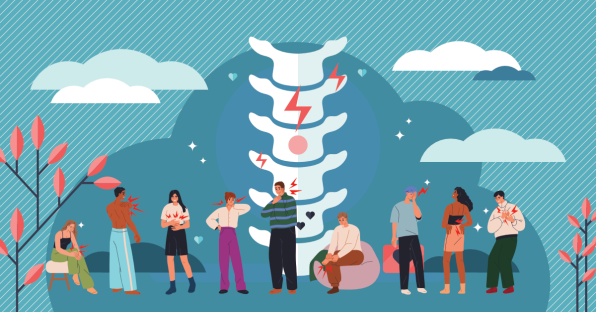
Pain doesn’t knock politely before entering your life.
Sometimes it strikes suddenly — like when you pull a muscle or suffer an injury. Other times, it shows up quietly, gradually weaving itself into your daily life until one day, you realise it’s always there. A background ache that doesn’t leave. A quiet intruder that’s become part of your routine.
Over the years, I’ve worked with many clients who’ve tried to make sense of this uninvited presence. In some cases, pain started after a specific event — an accident, a medical issue, something identifiable.
What I’ve consistently seen is that chronic pain doesn’t just take up space in your body — it seeps into every part of your life. It affects how you sleep, how you move, how you think, how you relate, and how you see yourself. I’ve had clients say, “I don’t know who I am without this pain anymore.”
And the question that always emerges — sometimes whispered, sometimes shouted — is: “How am I supposed to live when the pain feels unbearable?”
That’s where we begin. Not with easy answers or empty reassurance, but with tools grounded in science and shaped by compassion.
Understanding Pain: It’s More Than a Physical Signal
We’re often taught to think of pain as a straightforward warning sign — a message that something is wrong in the body. That model works for short-term pain, like when you twist your ankle. But chronic pain is something else entirely.
Pain starts in the nervous system, but it’s constructed by the brain.
A client once said, “I can feel my body all over my body but medical tests are always clear. Am I going crazy or are the doctors missing something?” It was a turning point when she learned her pain was real, but the source was now more about how her nervous system was interpreting signals, rather than something seriously wrong with her body.
Pain starts in the nervous system, but it’s created by the brain.
Our bodies have these tiny sensors — called nociceptors — that keep watch for anything that might be dangerous, like pressure, heat, or injury. When they pick something up, they send a signal up to your brain through the spinal cord.
But pain doesn’t just come from those signals.
Our brains decides whether or not to turn those signals into pain. It’s like your brain is asking, “Is this situation dangerous enough that I need to sound the alarm?”
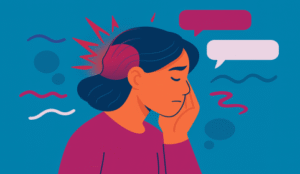
and that decision depends on way more than just what’s happening in your body.
Your brain takes into account things like:
If our brains think we need protecting, it turns up the volume on pain — even if your tissues are actually okay.
This explains why we can hurt a lot even when tests are normal — or why two people with the same injury can feel very different levels of pain. It’s not in the head. Our brains are just doing their best job — it’s just being a little too protective right now.
When the Alarm Gets Stuck On
Once we understand that pain is our brain’s way of trying to protect us, it makes sense that sometimes the system can go a bit overboard. For some of us living with chronic pain, it’s like our internal alarm gets stuck in the “on” position — even when there’s no immediate danger.
This is something called central sensitisation. It means our nervous system has become overly reactive — not just to physical injury, but to everyday stressors, movements, emotions, or even changes in temperature. Things that wouldn’t normally hurt now feel intense or unbearable. I once worked with a client who had injured his back at work who said, “Even a warm shower feels like sandpaper.” His nervous system wasn’t reacting to damage — it was reacting to anything it had learned to associate with threat. When we explored what might be keeping his system on edge — things like sleep deprivation, work and financial stress, and fear of not recovering — it started to make more sense to him. He could see that his body wasn’t failing him. It was trying, in its own way, to protect him.
When we recognise that the pain is still real, but the cause has more to do with an overactive alarm system than injury itself, it opens the door to a different kind of care. Instead of fighting our body, we can learn to support our nervous system — to help it settle, rather than stay stuck in defence mode.
We’re Not Broken — We’re Just Trying to Feel Safe

Fighting pain is completely human. Of course we want it gone — it’s exhausting, unpredictable, and limiting. But the constant mental and emotional battle against pain can leave us even more depleted. Acceptance doesn’t mean we’re okay with the pain, or that we stop caring about getting better. It simply means we stop wasting energy on the parts we can’t control — and we use that energy instead to move toward the parts we can.
We can start by practicing phrases like, “This hurts — and I don’t have to fight it right now,” or “This is here — and I can still choose what matters today.” When we make even a little space for our pain, we often make more room for life alongside it.
2. Watching Our Thoughts Without Getting Stuck in Them
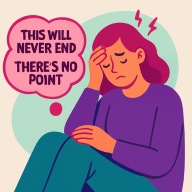
Pain doesn’t just affect our bodies — it floods our minds. Thoughts like “This will never end,” or “There’s no point trying,” can become loud, repetitive, and convincing. But we can learn to notice these thoughts without automatically believing them.
One practical approach is to practice defusion — noticing thoughts and labelling them: “I’m having the thought that I’m broken.” This simple shift helps us pause, step back, and ask ourselves, “Is this thought helping me?” It doesn’t mean the thought disappears, but it gives us more freedom in how we respond to it.
When pain takes up so much of our attention, it’s easy to forget who we are outside of it. But our pain is just one part of our experience — not the whole of our identity. We are still people who have stories, dreams, humour, creativity, and love.
Sometimes it helps to intentionally reconnect with things that reflect who we are. That might mean listening to music that brings us joy, telling a friend a funny story, or reflecting on a moment we felt proud of — even if it was small. These moments remind us that we’re still here, still whole, even in the midst of pain.
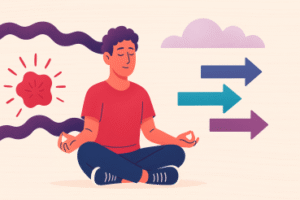
Pain pulls our attention by design — it’s the body’s way of saying something might not be safe. But when pain becomes chronic, focusing on it constantly can actually make it feel louder and more dominant in our lives.
This doesn’t mean ignoring pain or pretending it isn’t there — that rarely works. What helps is learning how to gently shift our attention when we can. At first, it might feel unfamiliar or even impossible — but like any new movement, it strengthens with practice.
Think of it like building a muscle. The first time we try to lift even a light weight, it feels shaky and awkward. But if we keep showing up — a few minutes at a time, day by day — our capacity grows. Shifting our focus away from pain works the same way. Every time we redirect our attention, even for a moment, we’re training that muscle. We’re increasing our tolerance, our flexibility, and our ability to stay connected to life, even while pain is present.
We might begin by noticing when we’re stuck in pain-focused loops — scanning our body, Googling symptoms, replaying thoughts like “how bad is it now?” Then we pause. We breathe. We might say to ourselves: “I notice what my mind is doing — and I can decide where to go from here.”
From there, we can experiment with placing our attention elsewhere — music, movement, connection, beauty, sensation, values-based action. Not to escape the pain, but to broaden our experience so that pain isn’t the only thing in the room.
Over time, these micro-moments of shifting focus help retrain the brain. We teach our system that there’s more to pay attention to than threat. And that helps reduce the brain’s need to keep sounding the alarm.
Pain often shrinks our world. We stop doing the things we care about, sometimes out of necessity, other times out of fear. But over time, that avoidance can leave us feeling numb, disconnected, and stuck.
Instead of asking “What can I no longer do?” we can gently ask, “What do I still care about?” and “What small version of that is still possible today?” Maybe we can’t go on a long hike in the countryside, but we can have a picnic in the sun for a few minutes. Maybe we can’t attend a full social event, but we can send a message to someone we love. It’s not about fixing the pain — it’s about choosing life in the middle of it.
Big leaps often feel impossible when we’re hurting. But small, consistent actions can be powerful. Even a two-minute stretch, a deep breath before getting out of bed, or making a simple meal can be acts of strength and care.
When we take one tiny step toward something meaningful — even if it’s uncomfortable — we start reminding our nervous system that movement, choice, and growth are still possible. This isn’t about pushing through or pretending to be fine. It’s about gently proving to ourselves that we’re still capable of creating direction.